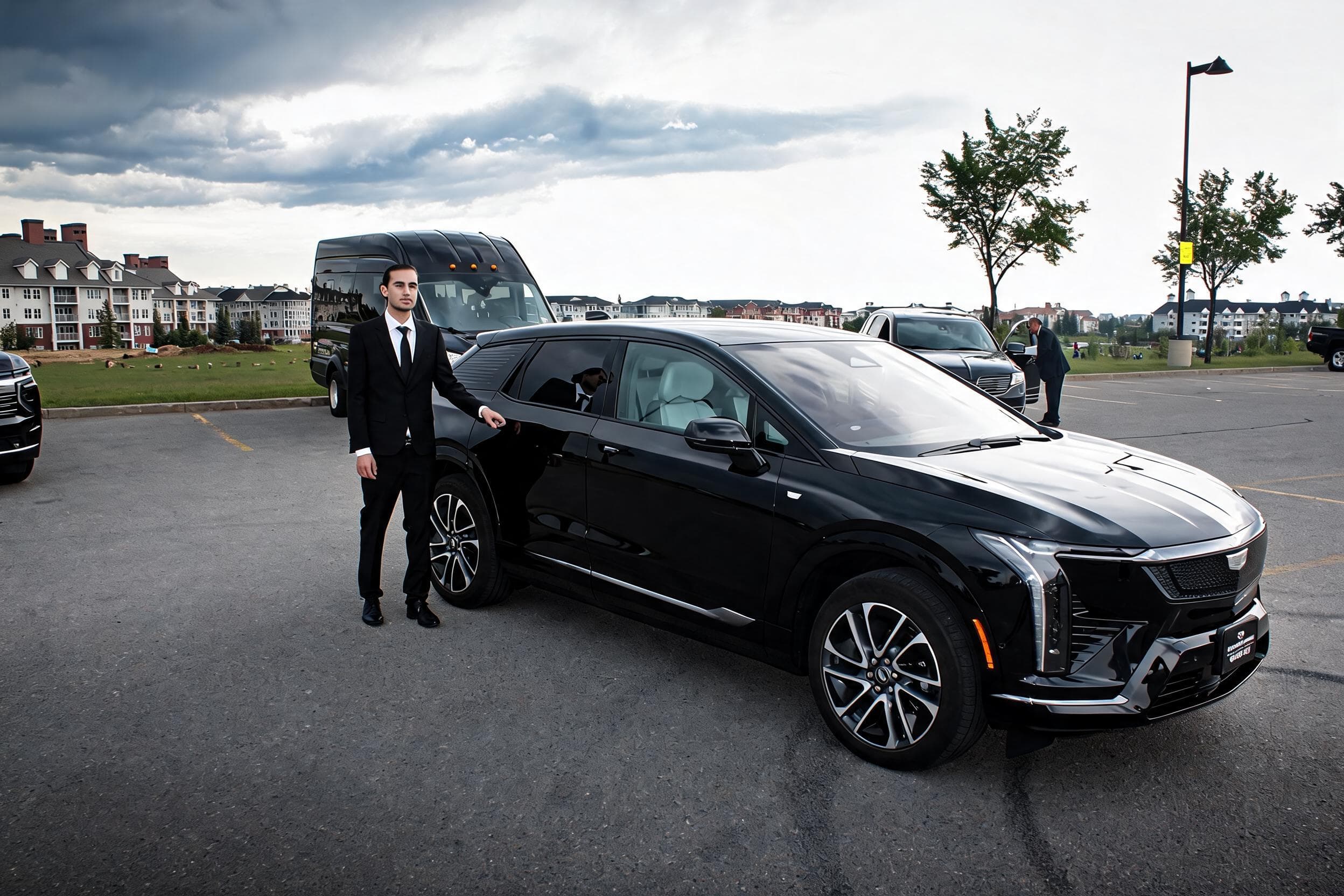
The short version: you tell us where you need to be and when, we quote it, a chauffeur picks you up at your door, and the same vehicle carries you and your luggage across the border and right to your departures curb. Most people have never booked a cross-border car and imagine it is complicated. It is not. Below is the whole process, step by step, including the part everyone asks about, which is what actually happens at the border booth.
What a Cross-Border Transfer Actually Is
It is a private ride, booked in advance, with one professional chauffeur and one vehicle for the entire trip. You are picked up wherever you are, whether that is a house in Calgary, a downtown office, a hotel in Banff or a terminal at YYC, and you stay in that vehicle until you reach your destination in the United States. There is no transfer point, no vehicle swap at the line and no rebooking of your bags. Your luggage goes in once and comes out once.
People book these for three main reasons. Some have been rebooked onto a flight from a US airport and need to get there. Some are heading to a wedding, a cruise, a conference or a golf trip where the connection through a Canadian hub is inconvenient. And some travel this way on purpose, because a long drive spent working or sleeping in the back of an SUV beats a day of terminals and gate changes.
What is included
- Door-to-door pickup and drop-off
- Luggage assistance at both ends
- Bottled water and in-vehicle WiFi
- Planned rest stops on long runs
What you handle
- Passports for every passenger
- Your own flight or hotel bookings
- Answering the officer's questions
- Telling us about oversized gear
Step by Step, From Quote to Curb
Request the quote
Send the pickup address, the destination airport or hotel, the date, the number of passengers and a rough count of bags. If you have a flight, send the flight number too.
We plan the route and confirm
We pick the crossing, build in border and rest-stop time, and come back with a firm all-in quote and a pickup time. Nothing gets added later.
Gather documents
Passports for everyone, kids included. Keep them in a jacket or a carry-on, never in a bag going in the luggage compartment.
Pickup day
Your chauffeur arrives early, loads the luggage and gets you on the road. You get a name and a phone number in advance.
The border
A short stop at the booth. Passports out, a few questions, then back on the highway.
Rest stops and the last leg
Coffee, food, a stretch. On overnight runs most people sleep through this part and wake up close to the airport.
Terminal drop-off
Straight to your departures curb with your bags unloaded for you. No shuttle, no parkade, no paperwork.
Book the ground leg first. If you already know you need to be at a US airport, lock the vehicle in before you finish sorting your flights. Vehicles and chauffeurs are finite, especially during a disruption week, and a confirmed ride gives you a fixed point to build the rest of the trip around.
Documents: Keep It Simple
Border documents cause more anxiety than they should. For a straightforward leisure or business trip, the list is short.
| Item | Who needs it | Notes |
|---|---|---|
| Valid passport | Every passenger | Infants and children too |
| US entry check | Non-Canadian and non-US passports | Confirm the current rules for your nationality before booking |
| Trip details | Anyone | Where you are going and roughly how long you will stay |
| Consent letter | A child travelling without both parents | Worth carrying, avoids questions |
Rules change, so treat the official government sources as the last word rather than any blog, including this one. If your group has a mix of nationalities, sort that out early. It is the one thing that can stop a trip, and it is far easier to solve two weeks out than at six in the morning on the highway.
What Really Happens at the Booth
This is the part first-timers picture as some kind of ordeal. In practice it is short and undramatic. Your chauffeur joins the lane, everyone stays seated, windows come down, and the officer asks the usual questions. Where are you going, why, how long, is anyone bringing anything to leave in the country. Passports get handed over, checked, handed back. Then you drive on.
Sometimes a vehicle gets directed to secondary inspection. That is routine and not an accusation of anything. You park, you wait a bit, an officer may look through the luggage compartment, and then you carry on. Because we build a buffer into cross-border quotes, a secondary check does not wreck the plan.
Small things that make the booth faster
- Passports in hand before you reach the lane, not buried in a bag
- Sunglasses off, phones down, one person answering unless asked otherwise
- Know your hotel name or the address you are heading to
- Declare food, alcohol and gifts rather than guessing
- Answer plainly. Short honest answers move fastest
Coutts and Sweetgrass on Highway 4 runs 24 hours, which is why it is our default for Montana. It means a 2 a.m. departure is a normal booking rather than a special request. Other crossings keep posted hours, and if your route uses one of those, the timing is planned around it before you ever get in the vehicle.
The Routes We Run Most
| From Calgary to | Distance | Approximate drive | Good for |
|---|---|---|---|
| Kalispell, MT (FCA) | About 460 km | About 4.5 to 5 hours | Closest US airport, Glacier and Whitefish |
| Great Falls, MT (GTF) | About 515 km | About 4.5 to 5 hours | Quiet airport via the 24-hour crossing |
| Spokane, WA (GEG) | About 700 km | About 6.5 to 7.5 hours | Wider carrier choice, mid-size and calm |
| Seattle, WA (SEA) | About 1,000 km | About 10 to 11 hours | Long-haul hub and cruise terminal |
Coming from the mountains instead of the city? Read Banff or Canmore straight to your US flight, because the Highway 93 South route skips the backtrack to Calgary entirely. Not sure which airport to aim for? Our alternate airports comparison lays them side by side.
Choosing the Vehicle
For one or two travellers with normal luggage, a luxury sedan is quiet, comfortable and easy to work in. For families and anyone carrying real gear, the SUVs do the heavy lifting: Cadillac Escalade, Chevrolet Suburban and GMC Yukon Denali, all with room for people and bags rather than one or the other. For a group, the executive Ford Transit van seats up to twelve to fourteen with full luggage, which keeps everybody together and turns a logistics problem into one pickup time.
If you are torn, our sedan, SUV or van comparison walks through passengers, luggage and comfort over a long drive. Tell us about skis, golf clubs, hockey bags, instruments or medical equipment when you request the quote and we will size the vehicle correctly the first time.
Tell Us Where You Need to Be
Send the date, the destination and how many people are travelling. We will come back with a route, a pickup time and an all-in quote, usually the same day.
24/7 Dispatch | Licensed and Insured | Professional Chauffeurs
Cross-Border Service FAQ
What documents does everyone in the vehicle need?
Which border crossing will we use?
Do we have to get out of the vehicle at the border?
How long does the border add to the trip?
Can we stop along the way?
Where exactly do you drop us off?
Is Lux Limo licensed and insured for trips into the United States?
A cross-border chauffeur trip is one of the least complicated ways to travel, which surprises people who have only ever done it by air. One vehicle, one chauffeur, one set of bags, and a plan that already accounts for the border. You get in at your front door and you get out at your terminal.
Send us the date and the destination. We will handle the rest of it.
Keep reading: Why you do not need a rental car |Calgary to Kalispell |Drive or fly?