Every December, Canadian law firms publish the same reminder to their clients: the company holiday party is a work event, and if alcohol is served, the employer's responsibilities do not end when the speeches do. The question that comes up most often is the drive home.
This post pulls together what those firms say, in plain language, and where transportation fits. It is written for the people who organise the party, not for lawyers.
The short version
There is no single rule that says an employer is or is not responsible when an employee drives home impaired after a work party. Courts look at the facts. In the cases commentators discuss most, three questions keep coming up:
- Did the employer supply the alcohol?
- Did the employer know, or should it have known, that someone was impaired?
- What reasonable steps did the employer take to get people home safely?
The third question is the one an organiser can do the most about, and it is the reason so much of the published guidance is about transportation.
Three cases commentators keep citing
Childs v. Desormeaux (Supreme Court of Canada, 2006)
This case was about private hosts, not employers. A guest drove home from a New Year's Eve house party far over the legal limit and caused a crash that killed one person and left another paralysed. The Supreme Court unanimously held that the private hosts did not owe a duty of care to the people injured on the road in those circumstances. The court distinguished private social hosts from commercial establishments, which sell alcohol for profit and are regulated. A summary by Peter Bowal and Preet Saini of the University of Calgary is published by LawNow.
Why it matters here: an employer hosting its own staff is not simply a private host at a house party. The employment relationship is a different starting point, which is why the next case is the one most often quoted to employers.
Jacobsen v. Nike Canada Ltd. (B.C. Supreme Court, 1996)
A young employee drank beer supplied by his employer while working at an event, went on to drink at bars, and was seriously injured in a crash driving home. The court held the employer 75 per cent responsible, relying on the employer's duty to take reasonable care for the employee's safe trip home, particularly because it had supplied the alcohol. A summary is published by Clark Wilson LLP.
Jenkins v. Muir (Alberta Court of Queen's Bench, 2012)
Closer to home, an Alberta court went the other way on different facts. An employee who had been drinking at an informal workplace gathering died in a collision after driving. The claim against the employer was dismissed: the employer had not supplied the alcohol, and no one had observed the employee to be impaired when the employer left, so the court found the risk was not foreseeable. A summary is published by Alexander Holburn Beaudin + Lang LLP.
Read together, the cases point the same way. Supplying alcohol, knowing about impairment and doing nothing increases risk. Planning and acting on that plan reduces it. None of this guarantees an outcome, which is why the steps below are framed as reasonable care, not as a shield.
What employment lawyers recommend
The published checklists overlap heavily. These are drawn from Cassels (2025), Littler (2019) and Clark Wilson (2010):
Getting people home
- Have a plan in advance for everyone who may drink to get home safely. Clark Wilson's examples are taxi chits or a booked chauffeured car service, and hotel rooms if the event is at a hotel.
- Provide rides for all attendees, not only the ones who seem impaired. Cassels strongly recommends taxi chits or ride-share vouchers for everyone who attends.
- Remind staff in advance to leave their cars at home on the day of the party (Cassels).
- Consider nearby hotel rooms for employees who live far from the venue (Cassels).
- If someone is intoxicated, stop further service, arrange a ride home at the company's cost or a family member to collect them, and if a person insists on driving, take the keys or call the police (Littler).
Running the bar
- Close the bar well before the party ends. Cassels suggests at least one hour before.
- Serve food, and always offer non-alcoholic drinks (Littler).
- Use drink tickets rather than an open bar, and do not allow drinking games (Littler).
- Use bartenders trained in responsible service. Littler's article names Ontario's Smart Serve; Alberta's equivalent program is ProServe.
Setting expectations
- Make attendance optional, and remind staff that workplace policies still apply at the party (Littler).
- Draw a clear line between the company event and any after-party that staff organise themselves.
Where booked transportation fits
Vouchers are good advice, and most checklists include them. Their weakness is that they depend on a taxi or rideshare being available at the moment someone wants to leave. On a Friday or Saturday night in December, after midnight, in the snow, that is the moment demand peaks across the city.
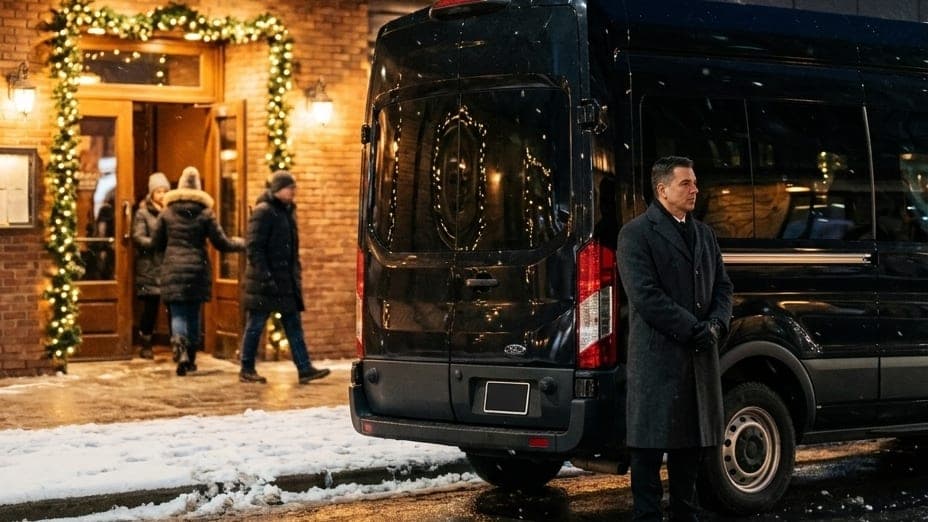
Booked vehicles with scheduled departures take that uncertainty out. The ride is waiting at the door at a known time, and the organiser can see who has left. In practice, many companies do both: booked departures for the main runs, and vouchers as the backup for anyone who needs to leave at another time.
To be clear about the limits: booking transportation is one reasonable step among several. It does not replace sensible alcohol service, a contact on the night who keeps an eye on things, or advice from your own lawyer.
If you are putting the plan together now, our office Christmas party transportation planning guide has a timeline and a staff email you can copy, and corporate holiday party transportation explains the three models that work for company parties. For how we run it, see our page on Christmas party transportation in Calgary.
A short pre-party checklist
- Ride home arranged for every attendee who wants one, announced in the invite
- Departure times set, with the last one after the bar closes
- Vouchers or a backup plan for anyone leaving at another time
- Bar closing time set well before the end
- Food and non-alcoholic options throughout
- A named contact on the night who is not the host
- Staff reminded to leave their cars at home
Related reading
Dates and vehicles for December 2026 are in our Christmas party limo and transportation guide. Not sure whether you need a van, a coach or a party bus? Read Christmas party shuttle vs party bus vs limo. And for December 31, see our New Year's Eve guide.
To price a plan, use the instant quote or call (877) 748-0138.